
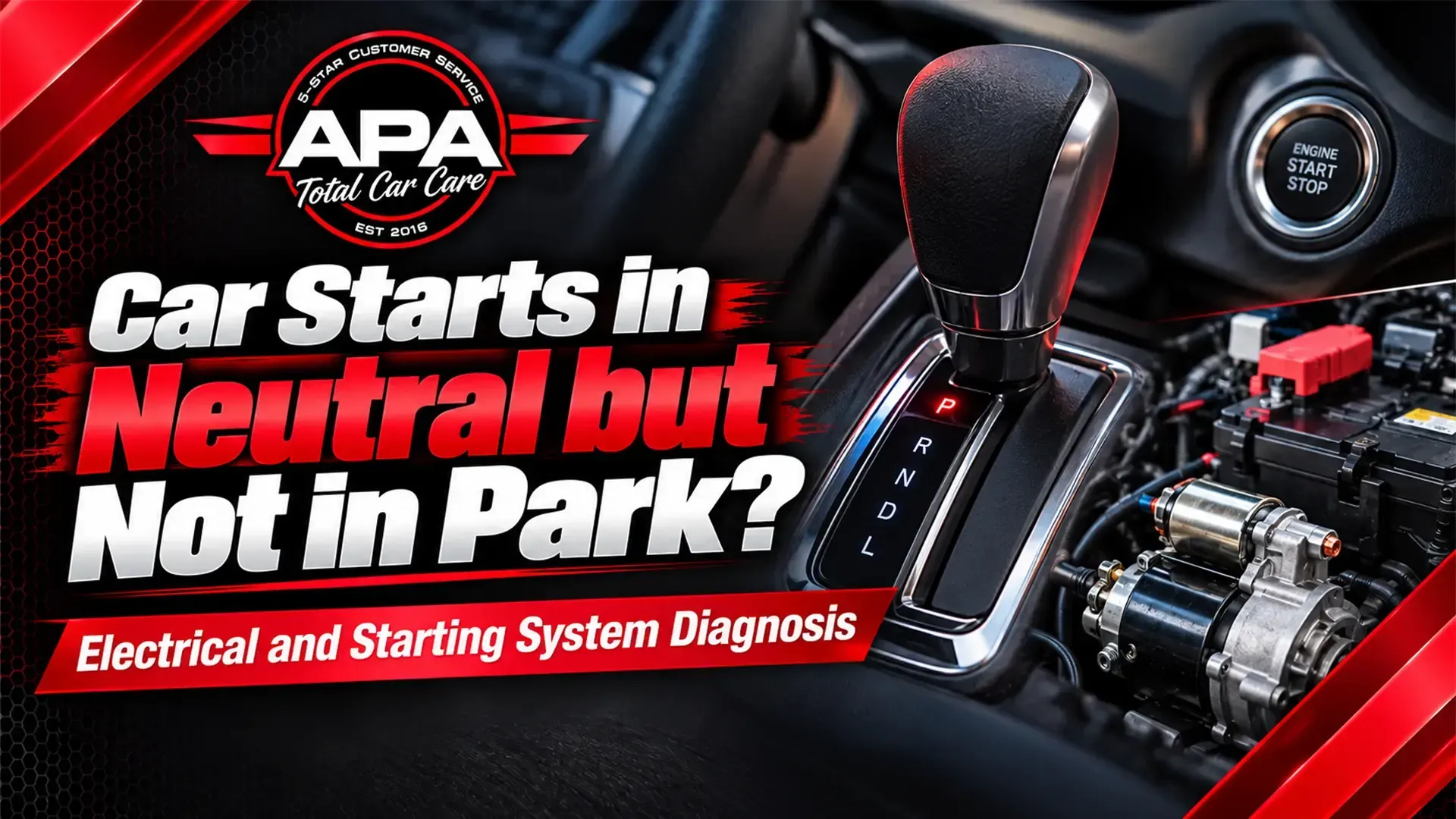
If your car starts in Neutral but not in Park, the vehicle may not recognize that the transmission is in Park. This problem often involves the transmission range sensor, neutral safety switch, shift linkage, wiring, or a related control circuit.
At APA Total Car Care, our
auto electrical repair in Queen Creek, AZ, includes starting-circuit testing before we recommend replacing any parts.
Why a Car Starts in Neutral but Not in Park
A vehicle that starts in Neutral but not Park often has an incorrect or missing Park-position signal. The control system permits cranking in Park or Neutral but blocks it in Drive or Reverse.
What the Park/Neutral Safety Circuit Does
The safety circuit confirms the transmission position before the starter can operate. Older vehicles may use a separate neutral safety switch, while newer models often use a transmission range sensor that reports several gear positions.
Common neutral safety switch symptoms include no cranking in one selector position, intermittent starting, or a gear display that does not match the shifter. Some vehicles may also turn on a warning light or store a diagnostic trouble code.
The Arizona Driver License Manual advises setting the parking brake and shifting an automatic transmission into Park when parking. If the Park signal is unreliable, keep the parking brake applied and arrange an inspection instead of treating Neutral as a permanent workaround.
Common Causes of a Park-Only No-Start
Several faults can interrupt the Park start signal, so the symptom does not identify one failed part. A technician must compare shifter position, electrical signals, and starter operation.
Misadjusted Shift Linkage or Cable
A stretched cable, worn bushing, or poor adjustment can keep the transmission lever from reaching Park. The cabin shifter may show Park while the switch sits outside its Park contact.
If your car won't start in Park, hold the brake, apply the parking brake, and move the shifter firmly into Park once. Do not force it or repeatedly move it while turning the key. A change after light shifter movement is useful diagnostic information, but it does not correct the worn or misadjusted part.
Worn Range Sensor or Neutral Safety Switch
A worn switch or range sensor may recognize Neutral but fail to report Park. Internal contacts can wear, loosen, or develop resistance, and the sensor may move out of alignment.
The exact component depends on the vehicle. Our shop services most makes and models, and our Chrysler repair and electrical service covers intermittent faults on models such as the Pacifica and 300.
Wiring, Connector, or Control-Circuit Faults
Damaged wiring, corrosion, loose terminals, a failed relay, or poor ground can interrupt the start request. Arizona heat can harden insulation and expose weak connections, especially after repeated heat cycles in a parked vehicle.
An electrical fault may appear only after a hot stop near Ellsworth Road or during a long San Tan Valley commute. Other clues can include flickering lights, blown fuses, or accessories that fail at the same time. Our recent guide explains why the same fuse keeps blowing and why repeated fuse replacement does not repair the circuit.
How Technicians Diagnose the Starting System
A proper starting system diagnosis confirms where the start command stops. It separates a shifter-position fault from a weak battery, cable problem, starter failure, ignition-control issue, or module concern.
Confirm the Symptom Before Replacing Parts
The first step is to reproduce the no-crank condition in Park and compare it with Neutral. A technician may check battery condition, terminal security, warning lights, gear-indicator behavior, and stored codes.
Temperature and timing matter. Tell the shop whether the problem happens after the vehicle sits in the Queen Creek sun or after a quick East Mesa errand. Also note whether it happens only on the first start of the day. Those details help technicians recreate an intermittent fault.
Test the Signal and Starter Circuit
Testing may include scan-tool data, switch alignment, continuity checks, voltage-drop measurements, and starter-control voltage. The goal is to verify whether Park is recognized and whether the command reaches the relay, solenoid, and starter motor.
If the start command reaches the starter but the engine does not crank, the starter or its high-current cables need closer testing. Our clicking, no-start diagnosis checks the battery, connections, starter circuit, and starter operation before replacement is considered.
What Queen Creek Drivers Should Do Next
Treat a Park-only no-start as a fault that needs diagnosis, even if Neutral still works. The condition can become intermittent in both positions and may eventually leave the vehicle unable to crank.
Set the parking brake and keep your foot on the brake pedal. Follow the owner’s manual if you must attempt one Neutral start to move the vehicle to a safe place. Do not bypass the safety switch, bridge starter terminals, or work under a vehicle that may move. For repeated symptoms, arrange professional testing rather than relying on shifter movement during daily East Valley trips.
Takeaways
When a car starts in Neutral but not Park, the starting circuit is usually missing a valid Park-position signal. Common causes include linkage adjustment, a worn range sensor or neutral safety switch, damaged wiring, poor connections, or a control-circuit fault.
The starter itself may still require testing, but replacing it based on this symptom alone can miss the cause. Record when the problem occurs, use the parking brake, and schedule diagnosis before the no-start becomes less predictable.
Frequently Asked Questions
Can I keep starting my car in Neutral?
No, you should not rely on Neutral as a long-term starting method. It may help move the vehicle to a safe place, but the failed Park signal or circuit still needs diagnosis.
Does starting in Neutral mean the starter is bad?
No, starting in Neutral does not automatically mean the starter is bad. Because the starter operates in Neutral, a switch, sensor, linkage, wiring, or control-signal problem is often more likely, though the full circuit should be tested.
How much does this problem cost to repair?
The repair cost depends on the failed part, vehicle design, and testing time. A linkage adjustment differs from replacing a range sensor or repairing damaged wiring, so diagnosis must come first.
Can Arizona heat cause a Park-only no-start?
Yes, Arizona heat can contribute to a Park-only no-start by worsening weak electrical connections, aged insulation, or marginal components. Heat alone does not prove the cause, so testing should confirm the failed signal or circuit.
Why does the car sometimes start in Park after moving the shifter?
Moving the shifter can temporarily align a worn switch, sensor, cable, or linkage well enough to complete the start circuit. That response is a diagnostic clue, not a repair, because the contact can fail again.
Schedule a Starting System Diagnosis in Queen Creek
Contact APA Total Car Care when your vehicle starts in Neutral but not Park, cranks only sometimes, or shows the wrong gear position. You can contact our Queen Creek team or call (480) 282-8300 to schedule electrical and starting-system testing.
Our shop is located at
22325 S Scotland Ct Ste 101, Queen Creek, AZ 85142. We will test the Park/Neutral signal and starting circuit, explain the findings, and recommend repair based on the results.
