
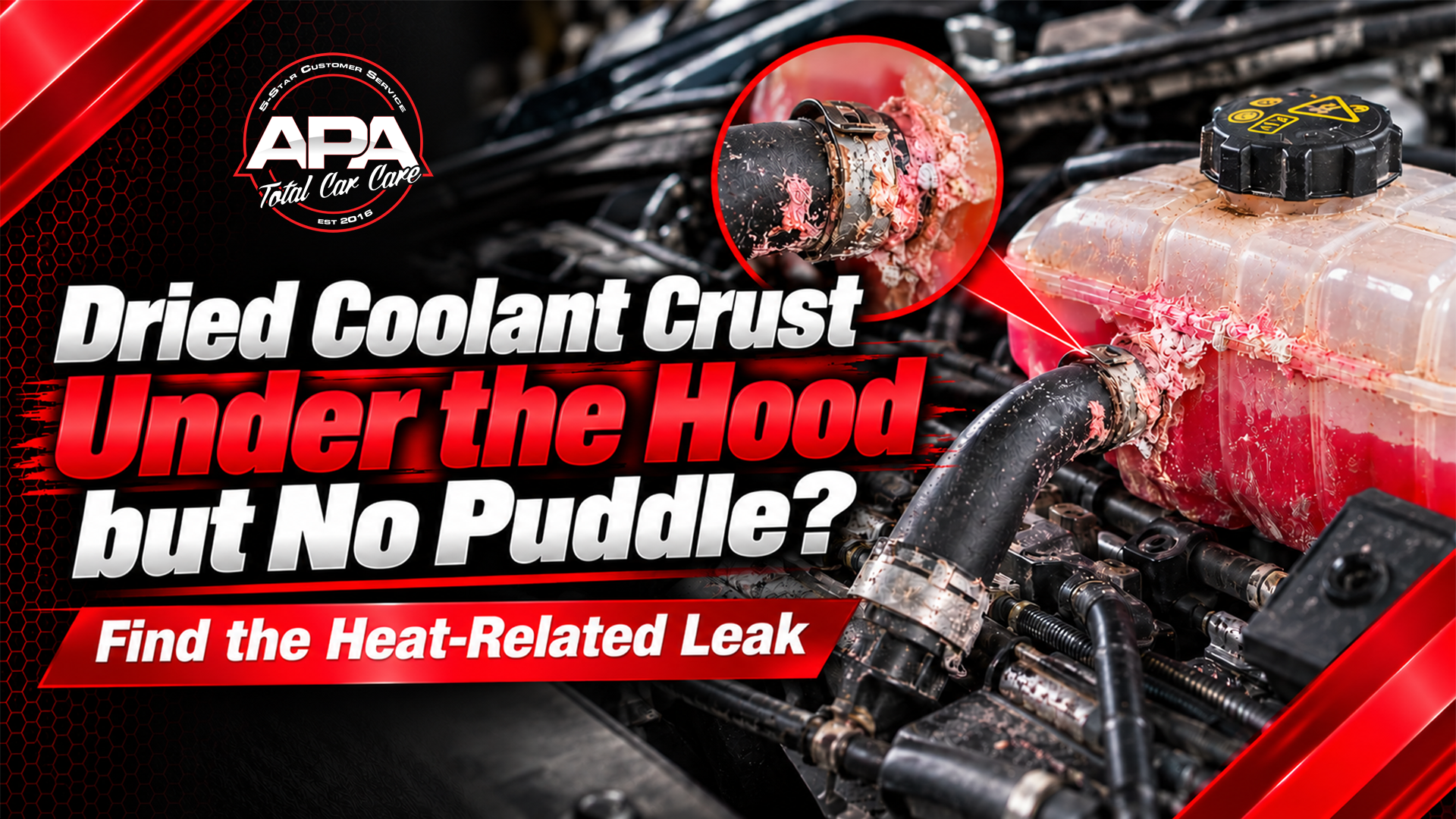
Dried coolant crust under the hood usually means a small leak has released coolant and the liquid has evaporated. In Queen Creek heat, the moisture may disappear before forming a puddle, leaving behind dye and mineral deposits.
Even without a visible puddle, a coolant leak deserves attention because the cooling system can gradually lose fluid and pressure. Our
radiator service in Queen Creek, AZ, includes cooling-system checks to help trace the residue to its source and identify the leak.
What Dried Coolant Crust Means
Dry crust or a chalky trail means coolant has escaped at some point, although residue alone does not prove the leak is active today. Coolant may leave a white, pink, orange, green, blue, or yellow deposit depending on its formula, age, and nearby dirt. Color is not a reliable way to choose replacement fluid. Your owner’s manual lists the correct coolant specification.
Our guide to
how coolant protects the engine explains why the fluid must carry heat and protect cooling-system parts. If the level keeps falling, the sweet smell returns, or fresh residue appears after driving, the leak is likely ongoing.
Why a Leak Can Leave No Puddle
A small opening may leak only after the system becomes hot and pressurized. The escaping coolant can mist onto a hot engine surface or run across a warm component and evaporate. Airflow while driving can also spread a tiny amount across the engine bay instead of letting it drip straight down.
Queen Creek’s long hot season speeds evaporation, so a heat-related coolant leak may be easier to see as crust than as wet fluid. A lower splash shield can also catch coolant and hide it from the driveway. Residue shows where coolant traveled, but the starting point may be above or beside the visible mark.
Common Heat-Related Coolant Leak Points
Small leaks often begin at a connection, seal, plastic housing, radiator seam, or pump vent. Heat cycles make rubber, plastic, and sealing surfaces expand and contract. That movement may open a narrow path only when the engine reaches operating temperature.
Hose Ends and Clamps
Hose connections often leave a ring of dry residue near a clamp or fitting. A hose may harden, swell, crack, or lose its seal where it meets the radiator, thermostat housing, or engine. Never tighten a clamp blindly because excess force can damage a plastic neck or distort the hose.
Radiator Seams and the Pressure Cap
Radiator seams can seep where a plastic tank joins the metal core, and the trace may dry along the edge. A weak pressure cap or damaged filler-neck seal can also release vapor and coolant near the top of the system. These faults may leave specks or a spray pattern rather than a single drip.
Thermostat Housing and Water Pump
A thermostat housing may leak around its gasket or develop a fine crack. A water pump can seep from its shaft seal or vent, then spread residue around the pulley area. Access varies by vehicle, and some leaks are difficult to see without removing a cover. For example, our verified Lexus repair and service in Queen Creek, AZ, includes cooling-system concerns such as leaks, rising temperatures, and heat warnings.
How to Inspect Coolant Residue Safely
Inspect the area only after the engine is completely cold. Hot coolant is pressurized and can cause serious burns. The Arizona Department of Transportation’s extreme-heat guidance also warns drivers never to remove a radiator cap while the engine is hot.
Check Only When the Engine Is Cold
With the engine cold, use a light to look around hose ends, the radiator perimeter, the reservoir, the cap area, and visible housings. Note the highest point where residue appears because coolant usually runs downward. Do not taste or touch the deposit, and keep coolant away from children and pets.
Do not add an unknown coolant type or mix products based only on color. If the reservoir is below its marked cold level, check the owner’s manual before adding anything. A large loss, steam, or an overheating warning calls for professional help rather than continued driving.
Track the Level, Smell, and Temperature Gauge
A photo and a cold-engine level check can show whether the condition is changing. Watch for a sweet odor after parking, a temperature gauge that climbs, weak cabin heat, or repeated low-coolant warnings. Stop safely and shut the engine off if it overheats. Continuing to drive can turn a small leak into major engine damage.
How Cooling System Leak Diagnosis Finds the Source
Cooling system leak diagnosis uses controlled testing and close inspection to separate an active leak from old residue. At our Queen Creek auto repair shop, we inspect the cooling circuit and explain the findings before recommending a repair. The correct fix depends on the failed part, its condition, and whether nearby components have also been affected.
Pressure Testing and Digital Inspection
A pressure test applies controlled pressure to a cool system so small external leaks can appear without a road test. A technician can inspect the radiator, cap, hoses, connections, thermostat housing, reservoir, and water pump area. Testing may also include the cooling fans and related electrical controls when temperature symptoms are present.
APA Total Car Care can document visible residue or leakage with digital inspection photos when helpful. If the system loses pressure but no external leak appears, further testing may be needed for an internal coolant loss. The goal is to locate the source before replacing parts.
Takeaways
Dried residue can be the clearest sign of a small coolant leak because Arizona heat may evaporate the liquid before it reaches the ground. Common sources include hose connections, radiator seams, the pressure cap, thermostat housing, and water pump.
Check only when the engine is cold, monitor the coolant level and temperature gauge, and avoid mixing coolant by color. A pressure test can help confirm whether the leak is active and identify the repair it needs.
Frequently Asked Questions
Can coolant leak only when the engine is hot?
Yes, coolant can leak only when heat and system pressure open a small gap. It may stop as the engine cools and leave dry residue.
What color is dried coolant residue?
Dried coolant residue may look white, pink, orange, green, blue, or yellow. Color varies by formula and contamination, so it should not guide a refill.
Can I drive with dried coolant around a hose?
Driving with dried coolant around a hose may be safe if the leak is no longer active and the coolant level is normal. However, an active leak or low coolant level can make driving risky. Do not drive an overheating vehicle and arrange an inspection if symptoms return.
Why is my coolant low if there is no puddle?
Coolant may evaporate on a hot component, collect on a splash shield, or leak inside the engine. An inspection can determine where the fluid is going.
Will a pressure test find a small coolant leak?
A pressure test often reveals a small external leak by making seepage visible on a cool engine. Some leaks still require further inspection under specific operating conditions.
Schedule Radiator Leak Diagnosis in Queen Creek
Dry coolant crust is worth checking before another hot East Valley drive. Contact our team or call (480) 282-8300. At 22325 S Scotland Ct Ste 101, Queen Creek, AZ 85142, we can test the system and explain the repair options.
